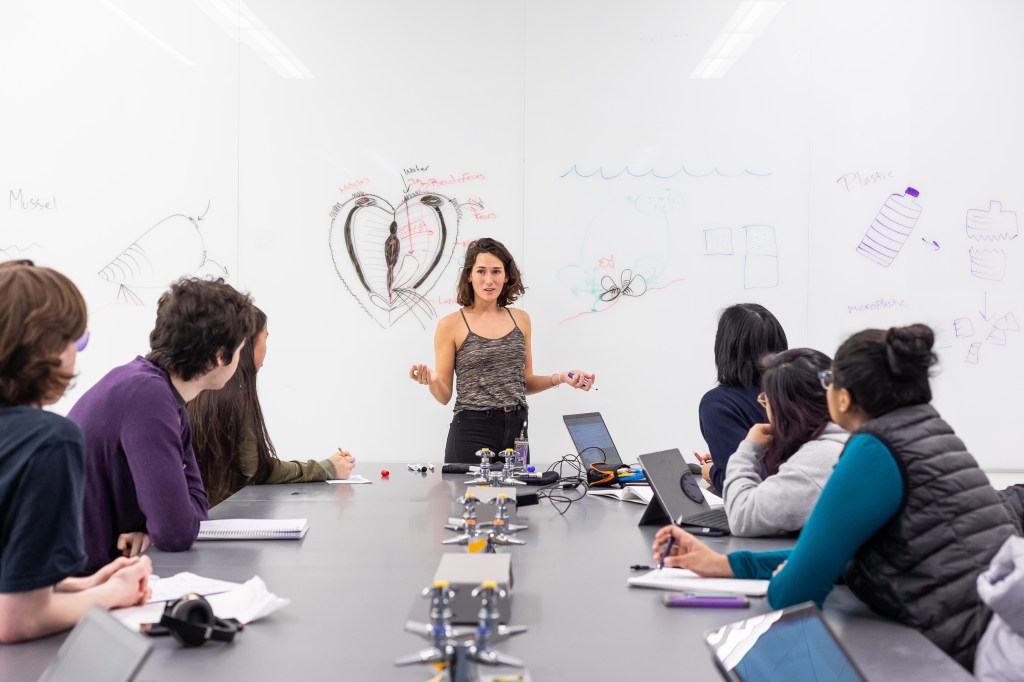
I value curiosity and intrigue from my students and push them to ask high level, interesting questions when I teach and mentor. Over the decade, I’ve worked hard to improve my effectiveness by honing methods that bridge knowledge and interest gaps, and become adept at adjusting my teaching and mentoring style to different types of students. I’ve observed that students readily learn difficult concepts when presented in a way that relates to them, whether as a “fun fact,” metaphor, or real life case study. These methods engage in a personal level, meeting students where they are at, and provide interesting yet easy to understand concepts that encourage participants to ask questions.
Environmental and Sustainability Courses
University of Washington (Main campus)
- Civilization Biology, University of Washington, Seattle, WA, 2018, 2019, 2020, Dr. Ben Wiggins
- Foundation of Physiology, University of Washington, Seattle, WA, 2016, 2018, 2019, Dr. Michael Kennedy
- Limnology, University of Washington, Seattle, WA, 2016, 2018, Dr. Daniel Schindler
- Foundations in Ecology, University of Washington, Seattle, WA, 2018, Dr. Hilary Hayford
- Marine Ecology, University of Washington, Seattle, WA, 2017, Dr. Jennifer Ruesink
- Introduction to Biology, University of Washington, Seattle, WA, 2015, 2016, 2017, Dr. Fredrick Dooley, Dr. Jake Cooper, Dr. Scott Freeman.
Friday Harbor Laboratories (UW)
- Pelagic Ecosystem Functions of the San Juan Archipelago, FHL, University of Washington, Friday Harbor, WA, 2017, Dr. Jan Newton, Dr. Matt Baker, Dr. Rebecca Guenther
- Marine Invertebrate Zoology, FHL, University of Washington, Friday Harbor, WA, 2017, Dr. Gustav Paulay and Dr. Peter Funch
University of Chicago
- Natural History of North American Deserts, University of Chicago, Chicago, IL, 2014, Dr. Eric Larsen
- Core Biology, University of Chicago, Chicago, IL, 2013, 2014, Dr. Beatrice Fineschi
Guest Lecture
- Sound Water Stewards, Whidbey Island, WA, 2020 – 2024
- Natural History of the Marine Environment, Friday Harbor Labs, WA, 2022
- Civilization Biology, University of Washington, Seattle, WA, 2020 – 2022
- Conservation Ecology for Graduate students, University of California Irvine, 2021
- Foundations in Ecology, University of Washington, Seattle, WA, 2018
- Marine Ecology, University of Washington, Seattle, WA, 2017
Student Mentoring

Washington State University
- Data Analytics Capstone Course – How climate change can affect manufacturing facilities at spacial and temporal scales (2023)
Plastic Tides Global Youth Mentoring Program
- Debris analyses and community conversations on one of the most polluted beaches in the world, Marcas Beach (John Abad; Lima, Peru; 2020 – 2021)
- Simplifying, organizing, and demystifying sustainability efforts in New York City (Naomi Sladkus; NYC, USA; 2020-2021)
University of Washington
- Mapping marine microplastic research institutions through time (Jackson Fennell; University of Washington, 2018-2020)
- Polymer analysis of marine debris in the Salish Sea using RAMAN spectroscopy (Harsimron Gill; University of Washington, 2018-2020)
- Polymer analysis of marine debris in the Salish Sea using RAMAN spectroscopy (Nell Baumgarten; University of Washington, 2018)
- Do marine microplastic publications influence public awareness? A comparison of publication metrics, news media coverage, and social media impact (Anthony Abruzzini; University of Washington, 2018)
- Is there a diffusion pattern of published marine microplastic research from 2008-2018? (Claire Hutchinson; University of Washington, 2017)
- Determining the distribution of microplastic in the Salish Sea (Louise Sutters; University of Washington, 2017)
Friday Harbor Laboratories (UW)
- Microplastic’s effect on marine mussel fecal matter and its integration into the coastal food chain (Jalene Weatherholt; University of Washington, 2016)
- The effect of microplastic and silt on the clearance rate of marine mussels (Diana DiMarco; Seattle University, 2016)
 Lyda Harris, PhD
You must be logged in to post a comment.