The town of Bahía de los Ángeles, Mexico, home of about 1,000 residents that also attracts many ecotourists and sportfishing enthusiasts, sits along the shores of a critically important but highly threatened marine environment that is home to transient whale sharks, sea turtles, and other endangered animals. Unfortunately, the town does not have a sophisticated dumping or recycling program, and the majority of debris ends up discarded or unchecked, either in the open dump or surrounding desert. Due to the shallow nature of the unofficial dump and lack of containment, a significant amount of debris is blown by strong westerly winds through the desert and into the ocean.
The project ran from October 2022 through September 2024 and had four primary community-driven objectives:
- Conduct and enact place-based plastic prevention programs.
- Engage and train local youths to become leaders and advocates for their environment, and specifically for debris prevention, within their community and on the Baja Peninsula as a whole.
- Debris monitoring and removal from beach and desert sites before it reaches the ocean.
- Disseminate finding and methods for the purpose of allowing other communities to replicate the project.
This project focused on place-based science, and centered youth and the community in methodology and approach. Additionally, visitors (tourists, educators, and scientists) from the US who visit Bahía de los Ángeles learned about the debris prevention efforts taking place in the town, and even participated in beach cleanup events and service projects, bringing their experience and knowledge back home with them. Finally, visiting graduate students, scientists, and tourists supported the project during their visits and brought home news of their experience and newfound knowledge.
Accomplishments
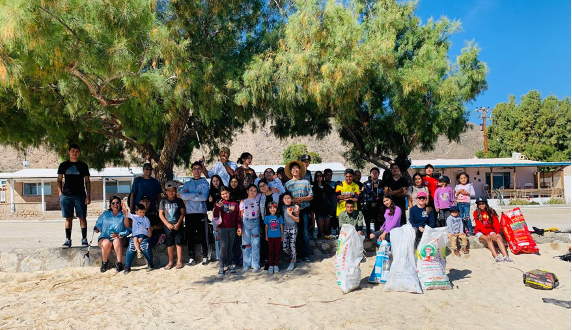
The Aventureros and greater Bahía de los Ángeles community conducted shoreline surveys, implemented a sustainable to-go container program, cleaned beach, ocean, and desert environments, hosted community events with outreach, education, and awareness components, created a central recycling facility, and implemented both informal and formal education on marine debris prevention and mitigation.

Debris Monitoring, Removal, and Recycling:
- 15 shoreline surveys conducted using the NOAA Shoreline Survey Protocol
- 55% of debris was plastic
- 13% of debris was glass or metal
- 73% of debris was found in the back barrier while only 27% was found on the beach
- 12 beach and marine cleans
- 4 desert cleanups
- 2,097 lbs of debris removed from marine environments (through NOAA protocols, beach cleans, and community events)
- 116 lbs of debris removed from the desert (through desert cleans and community events)
- Marea Viva was created as a community recycling, upcycling, and reusing hub
- 3,850 lbs of debris recycled, upcycled, or reused by Marea Viva (plastic, aluminum, and glass)
- PET accounted for 76% of plastic collected

Mitigation:
- 25 individual food-vendors subscribed to more sustainable to-go options over the course of the program
- 17,300 to-go plastic items replaced with more sustainable options
- In-town market carries more sustainable to-go options
- Hamburger Safari blog
Education:
- 79 youth from the community attended Aventureros and learned about plastic pollution and mitigation strategies
- 133 youth participated in at least one beach clean and the learning activities before and after the beach clean
- 4 different community groups or organizations partnered with us to teach Aventureros and community members something related to marine debris (e.g., Grupo Tortuguero, Mujeres de las Alas)
- 12 Aventureros received CPR and scuba certifications so they could learn about underwater pollution (and ecosystems)
- 65 public school teachers from the US and parts of Mexico visited and learned from the Aventureros
- 21 youth and community-members traveled to conferences, workshops or symposiums across Mexico to learn from others how they are mitigating plastic pollution
- > 30 unique learning activities were designed to educate youth and community members about marine plastic pollution. Many of these can be found in the The Plastic Project Handbook published providing an open-access educational approach to the plastic pollution problem (https://vermilionseainstitute.org/learn/)
Youth Leadership:
- 14 Aventureros advanced to become Guías (young eco tourism leaders)
- 3 Aventureros participated in Ocean Heros
- 15 shoreline surveys led by Aventureros using the NOAA Shoreline Survey Protocol
- 9 Aventurerors traveled to conferences, workshops or symposiums across Mexico to learn from others how they are mitigating plastic pollution
Community Engagement:
- 10 community events with a marine debris component (in addition to 15 shoreline surveys, 12 marine cleans, and 4 desert cleans)
- 710 total participants across all events, including 519 adults and 191 youth
- 465 individuals cleaned beach, ocean, and desert environments
- 209 visiting scientists partook in marine debris activities
- > 12 USA school and neighborhood cleans conducted as result of visiting scientists disseminating methodologies and learnings
- Frequent social media posts — often once a day during the summer months, or when other visiting groups were collaborating with us
- 3 “Trashy 1- Pagers” — or infographics on our research, findings and efforts were created and posted around town and shared digitally
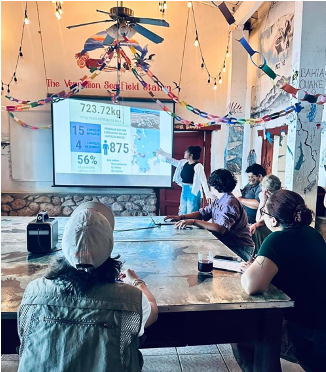
- 5 Spaghetti dinners were hosted where community members could come to the field station and learn about the project, help identify clean-up sites, and share other valuable perspectives related to the work.
Below is a short description of each event type:
| Debris monitoring and removal | |
| Shoreline Surveys | Monitoring efforts used English and Spanish versions of the NOAA Marine Debris Monitoring and Assessment Project (MDMAP) Shoreline Survey Guide. When available, the Aventureros led shoreline monitoring events with the community and visiting scientists. Continuous efforts focused on habitats vital to UNESCO, tourism, local economic resources, as well as created debris accumulation baselines, and provided insights into prevention efforts. |
| Beach and Ocean Cleans | Cleanup and debris removal events occurred during holidays, visiting group stays, and when the Aventureros were not available to lead shoreline surveys. Continuous efforts focused on habitats vital to UNESCO, tourism, local economic resources, as well as created debris accumulation baselines, and provided insights into prevention efforts. |
| Desert Cleans | Desert cleanup events were paired with hiking activities for the Aventureros in winter months. These cleans offered different perspectives and habitats related to the larger marine pollution issue, preventing debris from entering the ocean before it reached the shore. |
| Community Events | |
| Recycled Costume Contest | A costume contest with youth encouraged recycling old materials and waste to unique and new costumes. There were two age groups (younger and older youths) and prizes for most creative costumes. This event encouraged participation in debris conversations through a practical and fun lens. |
| Feria Ambiental | Environmental fairs were events that celebrated the environment and the great work ongoing in the community. In addition to inviting vendors to sell reusable and sustainable food and wares, events also invited other environmental groups to participate and host a table. To make the events fun for all ages, there were raffles and prizes to encourage attendees to visit all booths. |
| Pitch Azul | A shark-tank inspired event to generate enthusiasm, creativity, and community engagement. The event encouraged anyone to propose business/project ideas that help reduce waste and marine pollution in the community. Projects were judged by a multi-generational and cross-functional panel, providing advice and start-up money to the winner. After the presentations, everyone ate a spaghetti dinner together and celebrated the hard work of the Aventureros. |
| Spaghetti Dinner | Evenings inviting both community and expats to engage with Aventureros over food in an informal drop-in setting. During these dinners the Aventureros were able to communicate about their plastic prevent and removal work and engage dinner guests in related learning or feedback. |
 Lyda Harris, PhD
You must be logged in to post a comment.