
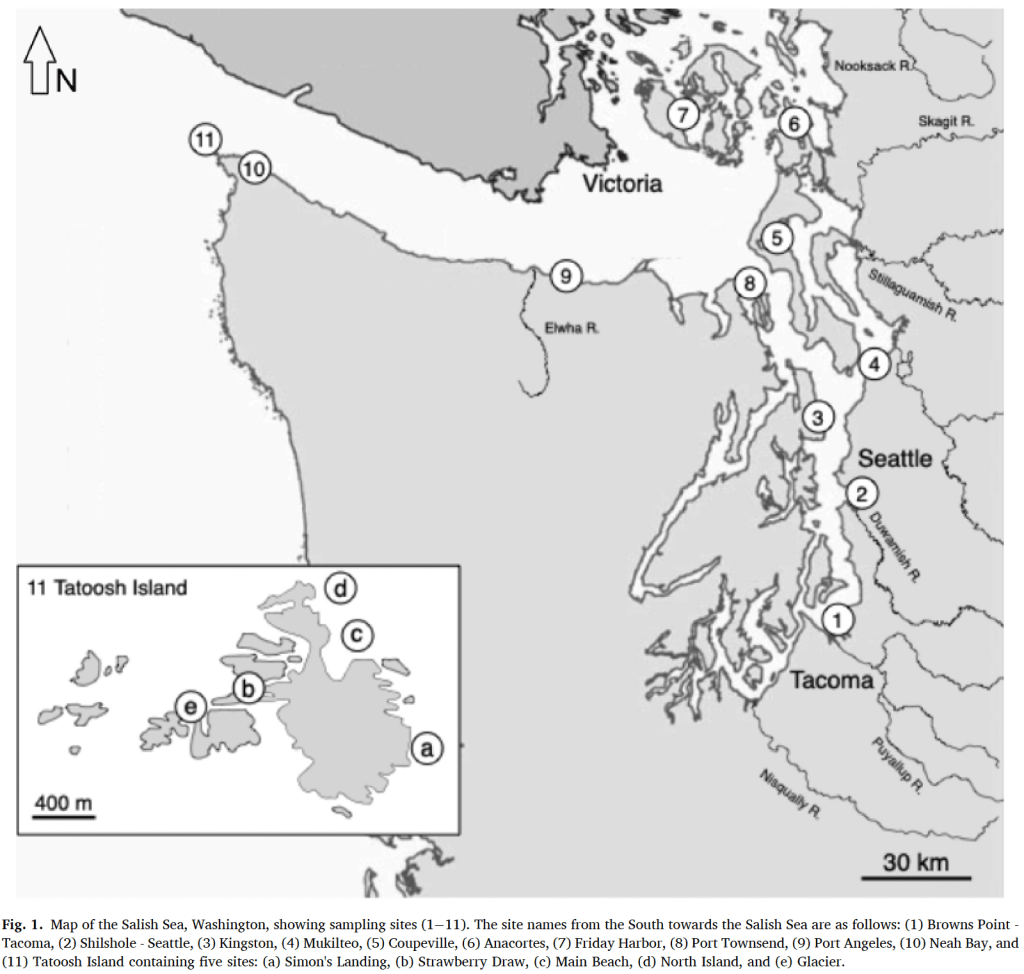
This project set out to map microparticle contamination in mussels (Mytilus trossulus) across the Salish Sea—from busy urban harbors to remote, rocky shorelines. What we found was surprising: mussel microparticle concentrations were relatively low and consistent across sites, with no clear urban-to-rural gradient. Even in areas littered with visible plastic waste, the mussels didn’t show high internal contamination. But nearly 20% of the microparticles we confirmed chemically were indeed synthetic plastic—including PET, PS, nylon, and polypropylene—suggesting mussels still ingest plastic, just not in overwhelming numbers.
To investigate regional and localized pollution patterns, this project collected mussels from 15 sites across the Salish Sea, including urban marinas and a remote island, Tatoosh. We used a rigorous wet oxidation process to dissolve mussel tissue, then vacuum filtered the samples to capture micro-sized particles. Every step was done under contamination-controlled conditions. Microparticles were analyzed for shape, color, and size with microscopy and ImageJ, and polymer analyses were done with Raman spectroscopy. Data were analyzed using R with a mix of nonparametric and multivariate statistical tests to compare particle concentration, shape, and color across sites.

Interestingly, over 60% of mussels contained at least one microparticle, but concentrations remained modest—averaging 0.75 microparticles per gram of wet tissue. Fibers dominated the contamination profile (over 80% of particles), with clear and blue as the most common colors. No consistent pattern emerged based on proximity to population centers, marina activity, or ocean basin. And while local mussels from Tatoosh Island appeared clean in the lab, the beaches were strewn with macroplastics—hinting at different transport dynamics for small and large plastic debris.
For decision-makers and coastal managers, these findings offer both caution and insight. Mussels can help track microplastic trends, but they may underrepresent true exposure levels due to selective feeding and fast egestion. Still, the confirmed presence of multiple plastic types inside wild mussels reinforces the need to reduce upstream sources of synthetic waste. In the race to understand marine microplastic pollution, mussels remain a vital, accessible window into what’s really floating below the surface.
 Lyda Harris, PhD
You must be logged in to post a comment.