The project outlines the first site-specific sustainability strategy for a large, global corporation. The organization launched a comprehensive corporate sustainability strategy rooted in cross-functional collaboration and long-term planning to advance its climate and sustainability goals. This initiative brought together teams from operations, facilities, engineering, product design, EHS, sustainability, and corporate leadership to align around a shared vision: proactively designing infrastructure and systems that reduce emissions, increase resilience, and promote transparent data tracking. The strategy aligns with industry best practices and supports both internal goals and external policy commitments.
Prior to this initiative, sustainability investments were largely reactive and capital expenditures were implemented through an ad-hoc, project-by-project approach. Recognizing the need for a more integrated and strategic path forward, the team conducted a benchmark study to compare its performance, practices, and ambitions with peer organizations across the industry. Insights from this study were used to build a forward-looking roadmap that prioritizes impact, cost-effectiveness, and scalability—moving the organization from one-off improvements to a cohesive, long-term vision.

Using an accelerator-style approach, the core team organized the strategy into an overarching framework to ensure alignment with corporate business strategy, stakeholder commitments, and manufacturing priorities. From there, the team targeted key focus areas such as building efficiency, electrification, water conservation, and renewable energy deployment. Each work stream featured high-impact actions—such as scaling LED upgrades, deploying smart occupancy sensors, and piloting on-site solar installations—paired with measurable KPIs to track progress. This sprint structure allowed for rapid iteration, learning, and adaptation as new data and stakeholder feedback emerged.
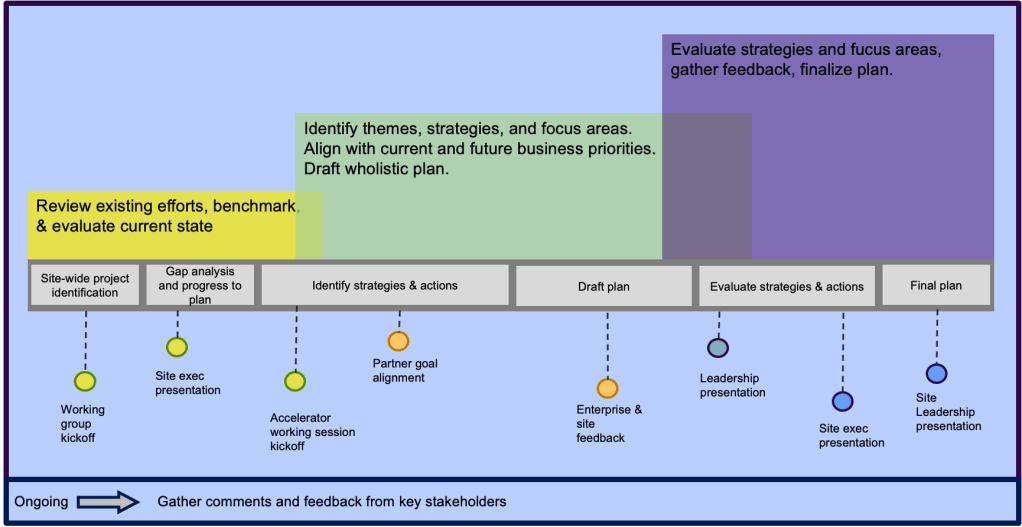
The strategy development process was both cross-functional and iterative. Leadership engaged a wide range of departments and stakeholders through workshops, benchmarking reviews, and scenario planning to ensure the strategy was grounded in operational realities and future-forward ambition. Teams refined approaches based on feasibility, cost-benefit analysis, and alignment with business priorities, creating a flexible roadmap for both immediate implementation and long-term transformation.
Ultimately, this corporate sustainability strategy represents a scalable model for embedding climate action into core operations. By combining agile planning methods, collaborative leadership, and data-driven decision-making, the organization established a blueprint for decarbonization and resource stewardship that supports both environmental outcomes and business performance.
 Lyda Harris, PhD
You must be logged in to post a comment.