Aventureros Averting Plastics for a Better Baja, driven by youth leadership, took significant steps toward preventing debris from entering the Bahía de los Ángeles Biosphere Reserve in the Gulf of California, Mexico. The youth, who participate in an environmental education and action program through Vermilion Sea Institute (VSI) called Aventureros, were drivers for each aspect of the project. The purpose of this approach, both in the program generally and in this project, was to develop a generation of environmental change makers on the Baja Peninsula and to ensure that the community of Bahía de los Ángeles, Mexico is well-prepared to prevent marine debris for decades to come. This program was uniquely able to connect with communities throughout the USA and inspire them to action through teacher education and collaboration.
The town of Bahía de los Ángeles, home of about 1,000 residents that also attracts many ecotourists and sportfishing enthusiasts, sits along the shores of a critically important but highly threatened marine environment that is home to transient whale sharks, sea turtles, and other endangered animals. Unfortunately, the town does not have a sophisticated dumping or recycling program, and the majority of debris ends up discarded or unchecked, either in the open dump or surrounding desert. Due to the shallow nature of the unofficial dump and lack of containment, a significant amount of debris is blown by strong westerly winds through the desert and into the ocean.
Together, the community achieved:
- 15 shoreline surveys conducted using the NOAA Shoreline Survey Protocol
- 55% of debris was plastic
- 13% of debris was glass or metal
- 73% of debris was found in the back barrier while only 27% was found on the beach
- 12 beach and marine cleans
- 4 desert cleanups
- 2,097 lbs of debris removed from marine environments (through NOAA protocols, beach cleans, and community events)
- 116 lbs of debris removed from the desert (through desert cleans and community events)
- Marea Viva was created as a community recycling, upcycling, and reusing hub
- 3,850 lbs of debris recycled, upcycled, or reused by Marea Viva (plastic, aluminum, and glass)
- PET accounted for 76% of plastic collected
- 25 individual food-vendors subscribed to more sustainable to-go options over the course of the program
- 17,300 to-go plastic items replaced with more sustainable options
- In-town market carries more sustainable to-go options
- 10 community events with a marine debris component (in addition to 15 shoreline surveys, 12 marine cleans, and 4 desert cleans)
- 710 total participants across all events, including 519 adults and 191 youth
- 465 individuals cleaned beach, ocean, and desert environments
- 209 visiting scientists partook in marine debris activities
- > 12 USA school and neighborhood cleans conducted as result of visiting scientists disseminating methodologies and learnings
A closer look
Collect plastic at specific location: Marea Viva
VSI conducted preliminary conversations with the town, schools, and Aventureros and determined to rethink the approach for collecting plastic at specific locations around the community. Early in the grant, VSI partnered with passionate community members to create Marea Viva, a place for plastics to be recycled, upcycled, and reused. Additionally, Marea Viva created an “eco-shop” (shop where plastics act as currency for highly needed items) and installed holding containers (super sacs). One of the goals of this project was to create recycling locations around the town, but after working with Marea Viva and receiving feedback from the community as well as increased hurricane events, we determined that one central location would work best and worked to support Marea Viva.

Repurpose, upcycle, and recycle plastic: Marea Viva
In addition to helping start a recycling center, Marea Viva, we also invested in equipment to recycle, upcycle, and recycle plastic from the community. Marea Viva has a grinder, extruder, and mold system that was installed early in the grant period. In doing so, Marea Viva has overcome many technical, financial, and physical barriers to running the equipment smoothly and efficiently. To repurpose and upcycle the plastics, Marea Viva has developed a rigorous protocol to prepare the plastic, including cleaning each container, removing stickers, and cutting plastics to fit into the grinder. Once the plastic is prepared, it is first ground into small shards by color, a specific weight is added to the injector/extruded (depending on mold type), and eventually pulled from the custom-made molds.
Reduce at source: Replace styrofoam to-go containers with more sustainable options
Throughout Bahía de los Ángeles the primary take-out container used by food vendors was Styrofoam at the onset of this project. To assess both the current state and needs of the community, we conducted Hamburger Safaris where Aventureros bought the same main dish from each vendor and weighed the to-go containers for analysis on how much plastic could be averted in the future. Containers were cleaned, dried, categorized, and weighed to determine baseline data of plastic, Styrofoam, fiber, and aluminum composition.
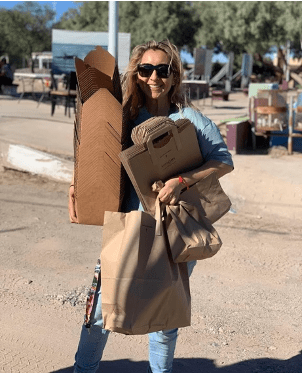
Next we based the subscription service for reusable or other more environmentally sustainable to-go containers on the top items used by the community. The items we selected for more sustainable options were industrially compostable – while Bahía de los Ángeles does not have a composting facility, the combination of wave action and UV indicated that even if these items ended up in marine environments the net result would be positive. In addition to physically replace to-go containers, the to-go container program aimed to increase awareness among both the local community and annual visitors.
The program started by giving free samples to food vendors. We then followed up and offered heavily subsidized prices to continue using the more sustainable to-go container options. Knowledge of the program grew by word of mouth and a year into the program the Bahía de los Ángeles community hosted an 85 person destination wedding over the entire weekend. Two vendors were hired for the party in part because those vendors could offer sustainable wares. A local chef cooking for the party asked specifically for a sustainable buffet and service ware (due to the remote desert destination, reusable-wares were not an option). Due to the community involvement and communication, over 3,000 plastic items were replaced in a single weekend!
Community awareness

We took an active participatory approach to community awareness in Bahía de los Ángeles, hosting 10 formal community events with an educational marine debris component, 15 shoreline surveys with debris removal, 12 beach and ocean cleans, and 4 desert cleans. These events, surveys, and cleans were primarily designed, organized, and facilitated under the guidance and lead of the Aventureros—who employed “The Committee Model” (see The Plastics Project Handbook page 13) and “Hosting Community Events” (see page 65). Our strategy for spreading awareness of the problem as well as sustained community engagement in plastic debris prevention was to ensure that all community activities had elements of learning or scientific research, relationship building, civic action, and fun. All events were designed to be intentionally inclusive of multigenerational and multilingual community members, as well as those with limited financial resources. Although beach surveys and cleans are quite physically demanding, we tried to organize most events to accommodate participants’ potential different physical abilities—offering alternative ways for participants to meaningfully contribute to community events as needed (e.g., meal prep, driving participants to survey sites, helping with publicity). Community participation and attendance was encouraged through publicly posted flyers, updates to social media accounts, and word of mouth.
In addition to the formal marine debris prevention activities, VSI began hosting spaghetti dinners half-way through the grant period to invite the town community, expats, and longer term visitors to engage with Aventureros over food in an informal drop-in setting. During these dinners the Aventureros shared about their plastic prevention and removal work and engaged dinner guests in games, mapping, and other learning activities. Sometimes spaghetti dinners were used to elicit community voice, concern, and feedback to guide the project and upcoming community engagement.
Social media posts, physical flyers, and informational tables at community markets or park events were also used to spread community awareness of the project, problem, and solutions. Aventureros helped co-design and disseminate this informational material, or teach community members in one-on-one settings.
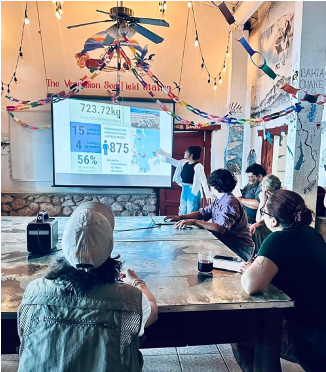
Furthermore, to engage community members who had been less involved in other activities and/or were more independent business/project oriented we held a town-wide, cash-prize competition for innovative and effective solutions to debris prevention toward the end of the grant. This competition—Pitch Azul—was inspired by the show Shark Tank and asked community members to “pitch” a place-based solution to overconsumption of plastic or plastic pollution to a panel of community leaders and local environmental experts. The competition generated a diverse range of new and innovative ideas and approaches from community members; it also created an opportunity for the community and Aventureros to learn from each other and engage in some (re)envisioning of systems, businesses, and upcycling could look like within the town.
 Lyda Harris, PhD
You must be logged in to post a comment.